

Ever looked at your dog and wondered, “How old is my dog in human years?” Many people still believe the simple 7 dog years = 1 human year rule, but the truth is much more interesting. Dogs grow, mature, and age in a completely different way than humans. That’s why a Dog Age Calculator can quickly help you understand your pet’s real age and life stage.
In this guide, you’ll discover how dog age really works, why breed, size, and genetics matter, and how modern science calculates dog years more accurately. If you want to know whether your dog is still a playful youngster or entering the senior stage, keep reading. By the end, you’ll understand your dog’s age in a way most pet owners never do.
Dog Age Calculator
Convert your dog’s age to human years with a chart-based estimate + optional science method.
1) Enter your dog’s age
2) Select size (or enter weight)
Results
Human age (Chart estimate)
Based on size-adjusted chart values.
Human age (Science method)
Uses ln-based aging estimate (extra reference).
Life stage
—
Disclaimer: This is an estimate. Dogs age differently by breed, size, and health. For medical advice, consult a veterinarian.
Understanding Dog Age in Human Years
When people try to convert a dog age into human years, many still follow the old belief that 1 dog year equals 7 human age. In reality, dogs age rapidly during the first few years, especially in the first year and second year of a dog’s life. Through my experience using a dog age calculator, I noticed that simple methods often miss how dog size, breed, and life expectancy change the way aging happens. A more accurate approach considers how dog aging develops roughly over time. For example, many charts estimate that the first year may equal about 15 human years, the second year adds around 9, and after that every year usually adds close to 5 more human years, depending on breed and dog size.
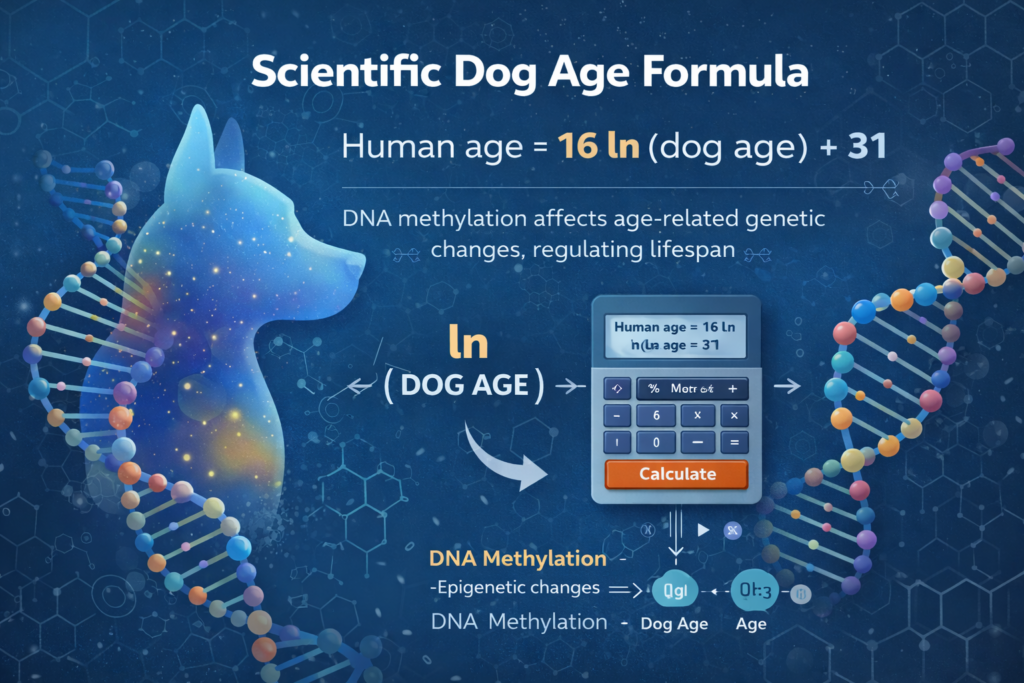
In 2020, researchers from the University of California San Diego (UCSD) proposed a scientific formula based on DNA methylation, which acts as a key biological marker of biological aging. Their study found that dog aging follows patterns closer to a logarithmic method rather than a straight line. The formula they suggested uses ln to measure aging changes, written as human age = 16 ln(dog age) + 31. This complex but more accurate method helps in determining the equivalent human years of a dog’s life. For instance, a dog age of 4 could already represent a mature stage in a dog’s life, while a dog age of 9 may already relate to senior health stages in some worlds best veterinary studies. Because growth speed may slow down after early development, modern scientific methods now includes these biological insights to better understand dog aging and improve pet health decisions when using a dog age calculator.
Simple Steps to Use a Dog Age Calculator
Using a dog age calculator is one of the easiest ways to understand your pet’s dog aging and overall canine aging. Many pet owners want to know how to calculate dog age in human years, especially when comparing their dog’s dog lifespan, dog life expectancy, and different dog life stages. Modern tools built on veterinary science and veterinary research now make this process simple while still giving an accurate dog age calculation.
Steps:
- Open a reliable dog years calculator tool or canine age calculator tool designed for dog age conversion and canine age conversion.
- Input dog age or enter dog years so the system can start the canine lifespan calculation.
- Select dog breed and choose dog size, such as small breed dogs, medium breed dogs, large breed dogs, or giant breed dogs, because dog breed size affects the dog aging rate.
- Many tools also check the dog growth timeline, including puppy age, adult phases, and senior dog age, which represent different dog development stages and dog maturity stages.
- Click calculate result to get an instant conversion that helps convert dog years to human years using a smart dog age formula or logarithmic formula.
- The dog age to human age converter then shows a clear pet age comparison, along with a dog age chart or dog age chart by breed to explain the full puppy to senior conversion.
How Dog Age Is Calculated
Many modern tools, including a scientific dog age calculator, use findings from the University of California San Diego (UCSD). Their studies connect DNA methylation, biological age, and aging biomarkers to better understand dog aging comparison and canine health metrics. Because of this research, tools like a dog age calculator by breed, dog age calculator by size, dog age formula calculator, puppy age calculator, senior dog age calculator, dog life expectancy calculator, and dog age estimator provide a more reliable way to calculate dog age and understand your pet’s real dog lifespan.
A dog age calculator gives a better view of a dog’s age than the old method of multiplyingdog years by 7. That rule is now seen as outdated and often inaccurate, because how dogs age changes a lot during the early years and also depends on dog’s size.
Steps:
- Start with the general guideline that many people know: 1-year-old dog does not equal just 7 human years.
- In the first year, a dog grows very quickly and becomes developmentally closer to a teenager in human’s life.
- According to the American Veterinary Medical Association and AVMA guidance, a 1 year old dog is approximately 15 human years.
- In the second year, the pace is still fast, so a 2-year-old dog is often about 21 in human years by the second birthday.
- After that, aging slows down, so experts do not use seven for every year or each human year anymore.
- Many modern calculations estimate about five years for every human year added later, though this is still a simple estimate.
- A 3-year-old dog may already be fully mature, which shows how a dog’s life develops much faster than humans in the beginning.
- A medium-sized dog may have a medium-sized dog’s life span of approximately 14 to 15 years, but this can change by breed and health.
- That is why a real dog age calculator looks at an important factor like dog’s size, breed data, and growth stage instead of one fixed rule.
- Sources such as veterinary hospitals, breed club surveys, statistics, and pet insurance companies have helped experts understand the real pattern of dogs age and where the old rule has big problems.
- For example, a 24-year-old person and a dog aged 4 or 9 years are not always directly comparable, because the timing of maturity and decline breaks the old general idea.
- So, to learn the true pattern of a dog’s life, experts compare age stages according to breed, size, and life stage rather than using one number for all dogs.
In many cases, most dogs mature fast at first, then show a dramatic slowdown after that. This is why modern age conversion gives a more realistic picture of life, human, and dog’s life stages when compared side by side.
Understanding the Core Principles Behind Dog Age Calculation
The idea of dog age calculation principles explains how tools like a dog age calculator convert dog years to human years using real dog aging science instead of simple guesses. Modern canine aging principles show that biological aging in dogs follows a changing dog aging curve, where early rapid aging in dogs happens during the puppy growth stages, followed by slower aging in later dog maturity stages and the senior dog age stage. In my experience reviewing different pet tools, accurate dog age conversion depends on understanding the full canine life cycle, including the dog development timeline, dog age growth pattern, and puppy to adult age conversion. Because each dog aging rate is different, experts analyze dog age factors like breed influence on aging, dog size impact on aging, and metabolism and dog aging. For example, small breed aging rate, medium breed aging rate, large breed aging rate, and giant breed dog aging all influence dog life expectancy, which is why a proper dog age by breed size comparison helps create a realistic pet age comparison.
Recent veterinary aging research and veterinary science dog aging studies improved the way experts determine dog age in human years. A well-known UCSD dog age study from the University of California San Diego dog research team introduced the logarithmic dog age formula, supported by DNA methylation dog aging and other canine biological markers. This discovery led to the modern dog age scientific formula, forming the base of many dog age estimation methods, dog age approximation methods, and the scientific dog age calculator method used today. Using this dog age algorithm, researchers perform canine lifespan calculation, build a dog age comparison chart, dog age conversion chart, and even a dog years chart to improve dog age mapping and dog age progression analysis. Practical systems also follow veterinary dog age guidelines, including the AVMA dog age guideline and the American Veterinary Medical Association dog aging model, which use canine health indicators and canine health lifespan metrics to calculate dog age accurately and support better biological dog age estimation while studying dog longevity factors and the natural aging slowdown in dogs.
The Scientific Formula for Dog Age
Modern research shows that a dog age scientific formula can explain aging better than old guesses. A scientific dog age calculator now uses biological data and math to improve dog years scientific calculation.
Steps:
- Scientists study the dog age formula and the canine aging formula to understand how dogs grow and age differently from humans.
- A well-known discovery from UCSD dog age research and the University of California San Diego dog study introduced the logarithmic dog age formula.
- The equation used in many tools is Human Age = 16 × ln(Dog Age) + 31, which acts as a dog age to human age formula for modern calculations.
- This approach relies on DNA methylation dog aging, a process linked to biological aging in dogs and used for canine biological age calculation.
- Scientists analyze methylation patterns in dogs and other biological markers of aging to understand the real aging process.
- These markers form part of the canine epigenetic clock and help track dog aging biomarkers across the dog aging curve.
- With the help of veterinary aging research and canine lifespan science, experts build a dog age research model for better predictions.
- Using this information, systems create a dog age algorithm and a dog age mathematical model to support dog age scientific estimation.
- This process forms a dog age logarithmic model and a complete dog age calculation equation that reflects real dog aging rate formula changes.
- These systems compare biological dog age vs chronological age to improve dog age prediction model accuracy.
- Modern platforms apply this dog age estimation method to calculate dog age scientifically using an accurate dog age calculator method.
- This technology supports dog longevity research, improves canine life expectancy science, and strengthens canine development and aging science.
- The results combine canine health and aging metrics, epigenetic aging in dogs, and new dog aging research findings.
- All these discoveries power the modern dog age calculator scientific method and help scientists understand the dog age biological clock more clearly.
Dog Years to Human Years Chart
A simple chart helps people see how a dog’s age relates to human’s age during the aging process. In many tools, a dog age calculator or calculator uses the dog’s breed, size, and development aging process to give a good sense of how a dog grows compared to a human.
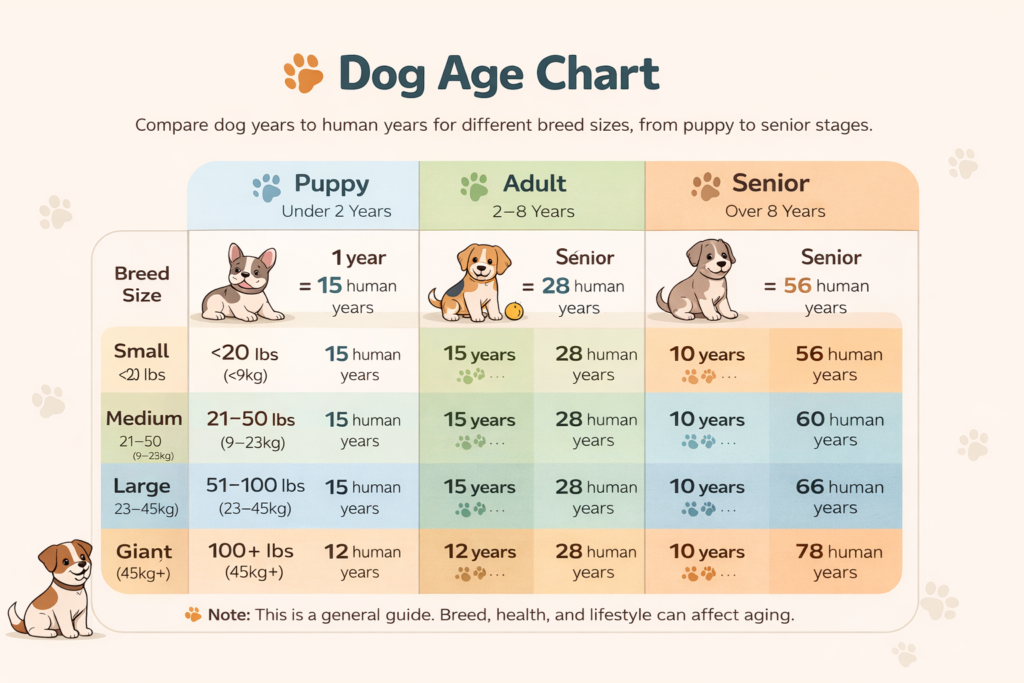
Dogs come in different sizes, and these differences affect how the process works. A small dog usually weighs 20 pounds or less, a medium dog or medium-sized dog is often between 21 to 50 pounds, while a large dog may weigh 51 pounds to 100 pounds, and a giant dog is often over 100 pounds. Because of these variations, the chart groups pets into small medium large giant categories so owners can see where their dog’s breed fits.
For example, a young dog’s age compares differently depending on size. A medium-sized breed may show a different development path than a large or giant dog. These changes explain why experts sometimes say to think like a dog and consider the dog’s background, the dogs growth speed, and the natural aging process before trusting a perfect calculator.
If someone wants more accurate results, it is smart to consult a vet because dogs of different sizes age at different speeds. Even with a helpful dog age calculator, factors like breed, dog’s background, and medium-sized or giant sizes still influence how a dog’s age changes over time.
Dog Age Chart by Size and Breed
A simplified chart helps owners visualize how dogs age depending on breed size and overall dog aging patterns. In my experience using a dog age calculator, the size factor plays a critical role in canine aging, because smaller breeds and larger breeds show clear aging difference in their dog growth and aging timeline.
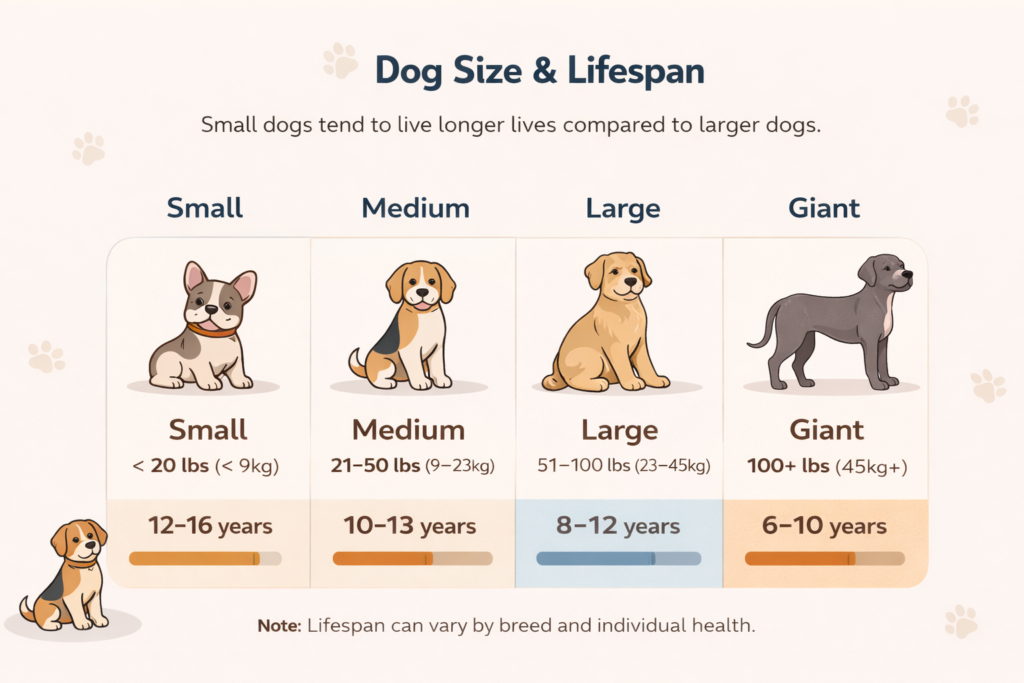
Usually smaller dogs tend to live longer and show a longer lifespan, while larger dogs often have shorter lifespans. This lifespan difference means smaller breeds often age more slowly, while larger breeds may age faster, creating a clear aging pattern in the canine lifespan chart and affecting the dog aging rate.
Because of the dog size impact, experts compare dog lifespan, breed lifespan, and dog life expectancy using a canine lifespan chart or a lifespan comparison model. This approach helps people help themselves understand the link between dog size and lifespan, the overall aging speed, and the natural rhythm of dog aging.
Do Dogs Really Age Seven Years for Every Human Year?
Many people still believe the dog years myth that 7 dog years to human years explains a dog’s age, but the dog age rule of seven is actually a dog aging myth. In reality, dog years conversion is more complex because dog years vs human years change during different dog development stages, from puppy aging stages to senior dog age. From my experience using a dog age calculator, a proper dog age comparison shows that the dog aging rate depends on breed size and dog aging, growth speed, and the natural dog growth timeline of the canine life cycle.
Modern dog aging science and veterinary science dog aging explain the dog age myth explained through real research like the University of California San Diego dog age study and UCSD dog aging research. Scientists studied DNA methylation dog aging, dog aging biomarkers, and canine biological aging to estimate biological dog age and design a better dog age formula. Their work introduced the logarithmic dog age formula written as Human Age = 16 × ln(Dog Age) + 31, which many tools use as a dog age conversion method in a scientific dog age calculator. Organizations like the American Veterinary Medical Association dog aging group and the AVMA dog age guideline also support this approach when studying dog lifespan factors, small breed aging rate, large breed aging rate, and overall canine life expectancy. These insights help create a reliable dog age chart, improve dog age estimation, show true dog age equivalence, and lead to accurate dog age calculation that reflects the real dog aging curve, revealing the dog age reality vs myth and a clearer dog age rule explanation.
Factors That Affect Dog Aging
Understanding factors that influence aging helps pet owners estimate a dog’s age more accurately. Experts and veterinarians explain that every dog ages differently depending on dog size, dog’s breed, and dog’s weight. These elements affect lifespan, life expectancy, and the moment a dog may enter senior years. Watching physical and behavior changes also gives a better idea about a dog’s overall health status.
Factors:
Dog Size and Breed:
Dog size has a strong impact on aging. Smaller dogs weighing 20 pounds or less usually live longer, while medium dogs between 21–50 pounds, large dogs around 51–100 pounds, and giant dogs over 100+ pounds may reach an age considered senior earlier.
Age Range and Senior Stage:
Dogs may enter senior years at different ages. Large breeds may show senior signs around 6–7 years, others around 7–9 years, 8–10 years, or even 9–11 years, depending on dog’s breed and lifespan.
Physical Signs of Aging:
Many older dogs show common signs like gray hair, graying on the dog’s muzzle, eyes cloudy, and changes in fur. These signs of aging may also include reduced activity levels, becoming less hyperactive, and acting more mellower than younger dogs.
Dental Health Changes:
Aging dogs may develop dental problems such as tartar, plaque, gingivitis, periodontal disease, and other dental changes affecting dog’s teeth. These issues can become severe if not treated through proper veterinary care.
Vision and Hearing Changes:
Older dogs may develop eye problems like cataracts, lenticular sclerosis, and reduced vision, sometimes leading to blindness. They may also experience age-related hearing loss that affects their hearing.
Body and Muscle Condition:
As dogs age, they may lose muscle mass or show reduced muscle mass, sometimes causing a small limp after exercise or favorite activities. This happens because the body gradually becomes worn during the aging process.
Health and Lifestyle Factors:
A dog’s dog’s health, pet nutrition, and activity level strongly affect aging speed. Regular vet visits allow a veterinarian to talk with pet parents, ask questions, and determine possible health problem risks.
Monitoring and Early Recognition:
Recognizing symptoms early can help your dog stay healthy and happy. By observing changes, monitoring behavior, and getting guidance from veterinarians, owners can better understand the aging process, no matter age.
Why Dog Size Affects Aging
In canine lifespan science, researchers often explain why dog size affects aging by studying the link between dog size and aging and the overall dog size impact on lifespan. Many dog breed longevity studies and veterinary research dog aging reports show a strong dog size lifespan relationship. For example, small breed dogs live longer, while large breed dogs age faster, and giant dogs shorter lifespan is common in many breeds. This pattern appears in dog aging comparison small vs large, where small dogs lifespan, medium breed dogs aging, large dogs lifespan, and giant breed lifespan differ clearly because of the breed size effect on aging.
The reason lies in canine biology of aging, where dog body size and aging connect with canine growth rate, dog development speed, and dog maturation rate. Larger breeds grow rapidly during early dog growth stages by size, which changes the dog aging rate by size and shapes the dog aging curve by breed size across the dog development timeline by size. According to veterinary science canine aging and pet health research dog size aging, factors like dog metabolism and aging, dog weight and lifespan, and the dog size influence on health act as key dog lifespan predictors. These findings support a broader dog aging model by size, explaining canine life expectancy by size and the natural dog size longevity rule observed in many dog aging patterns.
Can Breed Affect Dog Aging?
The question of whether dog breed and aging are connected is important when using a Dog Age Calculator. Many studies in canine longevity research and veterinary genetics dog aging show that breed affect dog aging because of canine genetics and aging and other dog genetics lifespan factors. For example, dog breed lifespan differences appear clearly when comparing small breed dog aging, medium breed dog aging, large breed dog aging, and giant breed dog aging. These breed-specific aging patterns explain why dog aging by breed and breed size and lifespan play a role in overall dog breed life expectancy and dog lifespan by breed.
Research in canine biology of aging also shows that hereditary traits in dogs and canine genetic health influence dog breed longevity. Some breeds face breed-related health conditions, breed predisposition diseases, or genetic disorders in dogs, which may affect the dog aging rate by breed and lead to different purebred dogs lifespan and mixed breed dogs lifespan results. According to veterinary research dog breed longevity and breed-specific canine lifespan studies, the link between dog development by breed type, pet genetics and longevity, and real dog breed health statistics helps experts understand canine hereditary aging factors and perform a clearer breed lifespan
Life Stages of Dogs
The dog life stages describe how dogs grow through different phases in the canine life cycle. It starts with the newborn puppy stage, which includes the neonatal stage, transitional stage, and socialization stage where early puppy growth phases and canine behavioral development begin. During this time, the puppy stage is important for dog physical development, dog mental development, and early dog development milestones in the puppy development timeline.
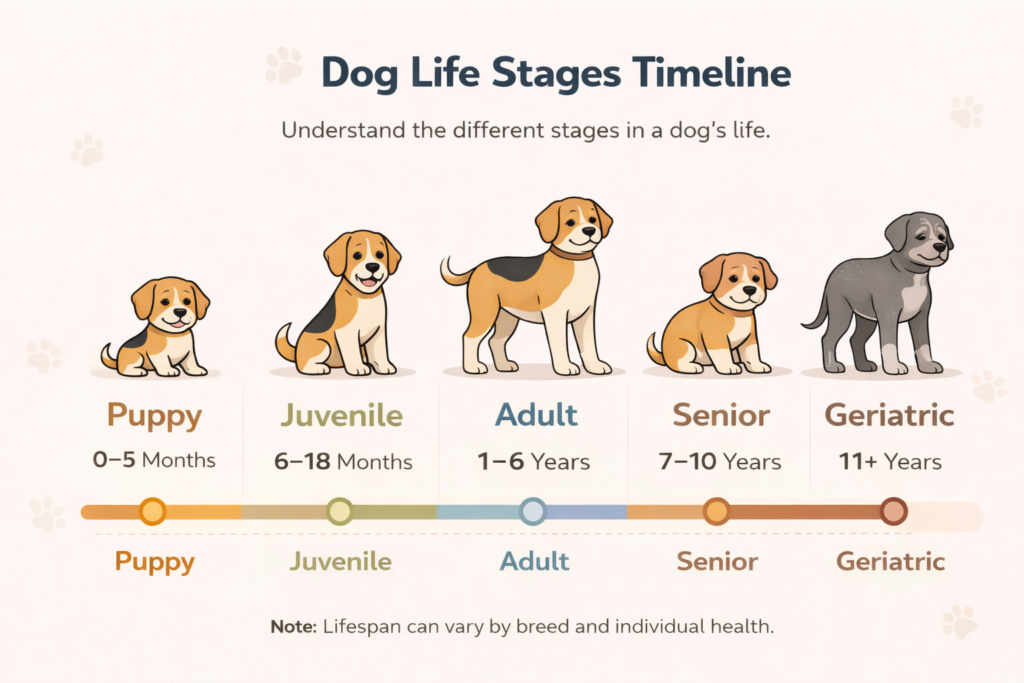
As the dog grows, it enters the juvenile stage and then the adolescent dog stage, where the puppy to adult transition shapes behavior and learning. Later, the dog reaches the adult dog stage and mature adult stage, showing full dog maturity stages and a stable dog maturity age in the dog development timeline.
With time, dogs move into the senior dog stage and finally the geriatric dog stage, showing natural dog aging stages, dog aging phases, and overall dog aging progression. According to veterinary life stage guidelines and pet life stage classification, experts organize these phases into dog age categories and a dog life stage chart to explain canine lifespan phases, dog lifespan stages, and complete dog life expectancy stages based on canine lifecycle research and veterinary science dog development.
Limitations of Dog Age Calculators
A dog age calculator can give a quick estimate, but experts often discuss the dog age calculator limitations and the limits of dog age calculators. Because dogs age differently, tools may face dog age calculation errors and inaccurate dog age estimation.
Steps:
- Many tools rely on simplified formulas, which leads to dog age conversion limitations and highlights the limitations of dog years rule and common dog years myth limitations.
- Some calculators depend on fixed equations, but there are dog age formula limitations and scientific dog age model limits, which can cause dog age calculator accuracy issues.
- A major challenge is variability in dog aging, where breed differences in aging and dog size impact on aging create different aging speeds.
- Biology also matters. Genetic factors in dog aging and the difference between biological vs chronological dog age increase canine aging complexity.
- Environmental conditions affect aging too, including environmental influence on dog lifespan, nutrition effects on dog aging, and lifestyle impact on dog longevity.
- Health conditions also matter because dog health status influence can change the results and create dog age estimation challenges.
- Scientists studying veterinary research dog aging variability have found large canine lifespan variability, which creates dog aging uncertainty.
- These variations also lead to dog aging pattern differences, dog development variability, and dog age comparison inaccuracies.
- Because of these factors, experts explain the dog lifespan prediction limits and dog life expectancy prediction limits of many tools.
- Research also highlights dog aging research limitations and dog aging model constraints when studying dog breed lifespan differences.
- Modern studies in veterinary science dog age estimation try to reduce these problems, but dog age calculator assumptions still exist.
Because of all these factors, tools can only give an estimate rather than an exact age. Understanding canine age estimation limits and the many factors affecting dog aging helps pet owners interpret calculator results more realistically.
Final Words
Understanding your dog’s real age is more than just curiosity—it helps you care for your pet in the right way at every stage of life. A Dog Age Calculator gives a helpful estimate by considering factors like breed, size, growth rate, and lifespan, which makes it far more useful than the old 7-year rule. When you know whether your dog is in the puppy, adult, or senior stage, you can adjust nutrition, exercise, and veterinary care to keep your pet healthier and happier.
Still, remember that every dog is unique. Genetics, lifestyle, health conditions, and environment can all influence how dogs age over time. Use a dog age calculator as a smart guide, but always combine it with regular vet checkups and careful observation of your dog’s behavior and health. In the end, the goal isn’t just to know your dog’s age—it’s to help your companion enjoy a longer, healthier, and more joyful life by your side.
Frequently Asked Questions
What is considered a senior dog?
A dog is generally considered a senior when it reaches about 75% of its expected lifespan, though the exact age varies by size and breed. Small dogs may become seniors around 9–11 years, while large or giant breeds can reach senior status as early as 6–7 years.
Why do small dogs live longer than large dogs?
Small dogs usually live longer because large breeds grow faster and age more quickly, which places more stress on their bodies and organs. This faster growth and metabolism often leads to shorter lifespans in bigger dogs.
Is the dog age calculator accurate?
A dog age calculator provides a useful estimate, but it is not perfectly accurate. A dog’s true aging process depends on breed, size, genetics, health, and lifestyle, so calculators should be used as a general guide rather than an exact measurement.
Does gender affect dog aging?
Gender can influence dog aging slightly. In some studies, female dogs tend to live a bit longer than males, but the difference is usually small compared to other factors like breed, size, and overall health.
