Can Dogs Eat Okra? Safety, Risks and Serving Guide
Can dogs eat okra? In most cases, a healthy dog can have a small amount of plain okra as...

Can dogs eat okra? In most cases, a healthy dog can have a small amount of plain okra as an occasional treat. Okra is not generally regarded as toxic to dogs. However, it can cause gastrointestinal upset, become a choking hazard, or turn unsafe when fried, pickled, heavily salted, or cooked with onion or garlic.
I understand how worrying it feels when your dog grabs an unfamiliar food. The safest response is to identify the amount, preparation method, and every ingredient in the recipe.
Plain boiled or steamed okra, cooled and cut into bite-sized pieces, is the lowest-risk option. Call a veterinarian promptly if the dish contained a known toxin or your dog develops repeated vomiting, breathing trouble, marked weakness, collapse, or severe abdominal pain.
Can Dogs Eat Okra Safely?
Yes, most healthy adult dogs can eat a small amount of plain okra. The tender okra pod and its seeds are generally edible. However, no research-based serving size has been established specifically for dogs.
Start with one small piece, introduce it gradually, and keep it within your dog’s daily treat allowance.
Safest way to prepare okra
-
Wash it thoroughly
Rinse the okra under clean running water.
-
Trim the tough stem
Remove the firm stem end before serving.
-
Steam or boil it plain
Do not add oil, butter, salt, sauces, or seasoning.
-
Let it cool completely
Never offer food that is still hot.
-
Cut it into bite-sized pieces
Use smaller pieces for puppies, toy breeds, and senior dogs.
-
Offer one piece first
Watch for vomiting, diarrhea, gas, bloating, or discomfort.
Is Okra Toxic to Dogs?
Plain okra is not generally considered poisonous in veterinarian-reviewed pet guidance. Still, “not toxic” does not mean “safe in every form” or “appropriate in unlimited amounts.”
The complete recipe matters more than the okra alone. Onion and garlic can damage canine red blood cells and cause hemolytic anemia. Raw, cooked, powdered, and concentrated forms can all be dangerous.
High-fat preparations may also cause significant digestive upset and may contribute to pancreatitis in susceptible dogs. Risk varies according to the dog’s size, age, medical history, amount consumed, and preparation method.
Okra Safety Levels Explained
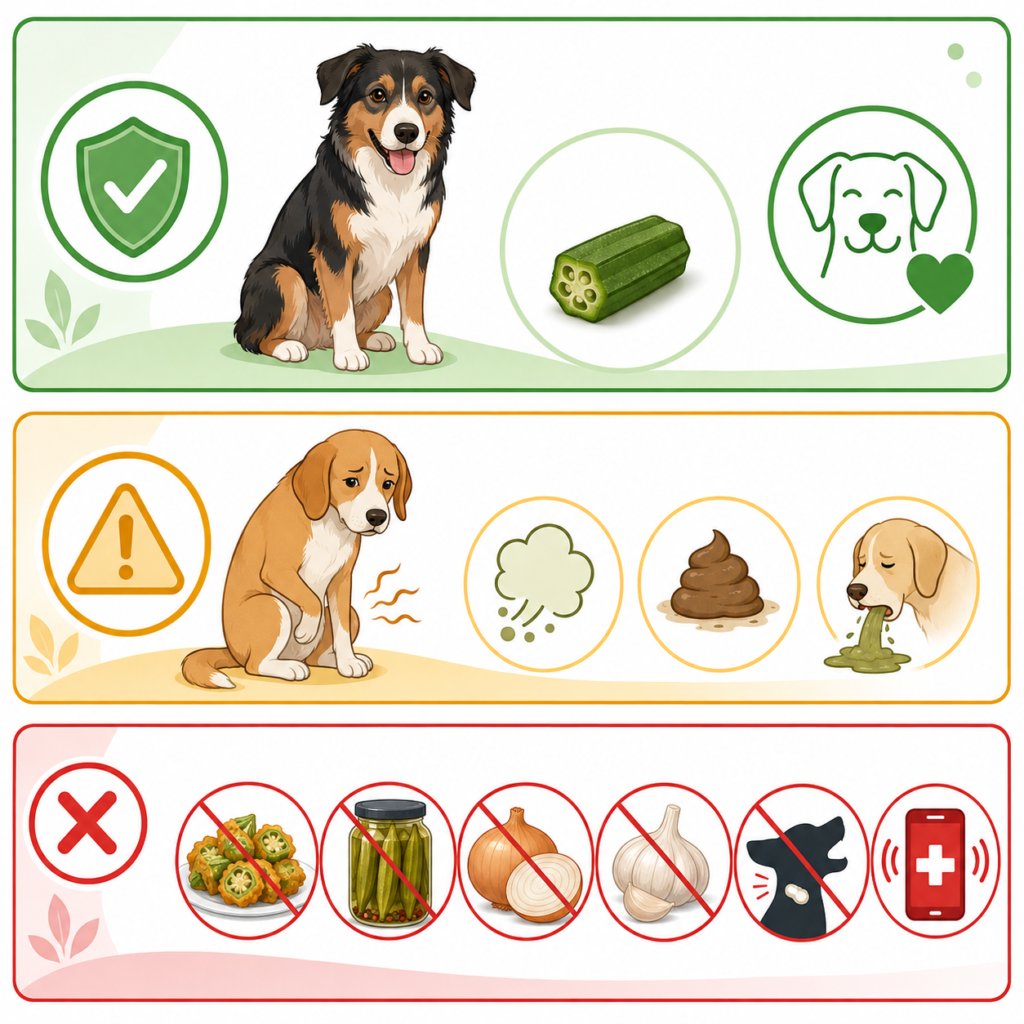
Usually Safe in a Small Amount
A healthy dog that eats one small piece of plain, cooked okra and remains comfortable will usually need observation rather than emergency treatment.
Provide access to fresh water. Do not offer more okra until you know your dog tolerates it.
Possible Mild Digestive Upset
Okra contains dietary fiber and a gel-forming substance called mucilage. A sudden increase in fiber may cause:
- Gas
- Bloating
- Soft stool
- Diarrhea
- Nausea
- Vomiting
- Reduced appetite
Mild symptoms may settle after the food passes through the digestive system. Stop feeding okra and contact your veterinarian if symptoms persist, recur, or worsen.
Potentially Dangerous or an Emergency
Seek urgent veterinary advice when okra was served with:
- Onion, garlic, leeks, shallots, or chives
- Xylitol or another unsafe sweetener
- Alcohol or caffeine
- Heavy salt, brine, or salty seasoning
- Large amounts of oil, butter, or fatty meat
- A bone, skewer, wrapper, or other foreign object
Emergency signs include choking, trouble breathing, repeated retching, collapse, tremors, pale gums, severe weakness, abdominal swelling, bloody diarrhea, or repeated vomiting.
What to Do If Your Dog Ate Okra
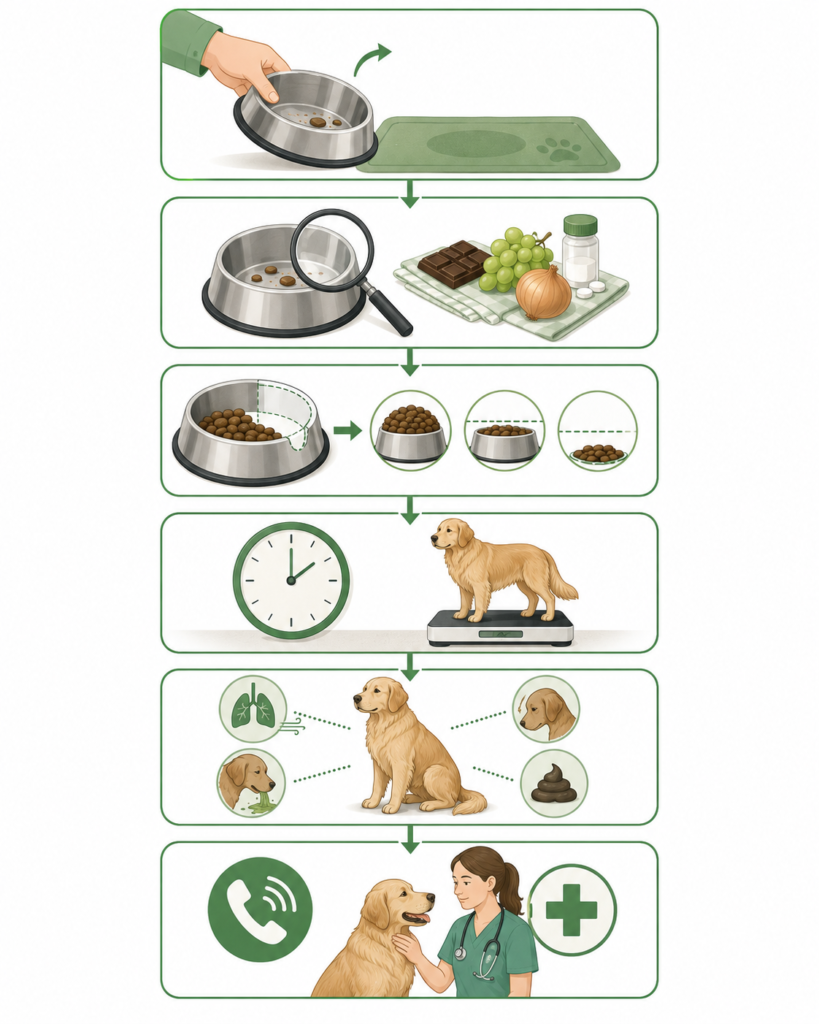
What to Do
- Stay calm and remove the food. Prevent your dog from eating more.
- Identify the preparation. Check whether the okra was raw, boiled, steamed, fried, pickled, canned, or part of a mixed dish.
- Estimate the amount and time. Note how much your dog may have eaten and when it happened.
- Read the complete ingredient list. Check sauces, stock, breading, spice mixes, and garnishes.
- Record relevant details. Note your dog’s weight, age, medical conditions, and current medications.
- Watch for symptoms. Monitor breathing, behavior, appetite, vomiting, and stool.
- Contact a professional when needed. Call a veterinarian or pet poison service if a toxic ingredient may be involved.
ASPCA Animal Poison Control can be reached at 888-426-4435. Pet Poison Helpline can be reached at 855-764-7661. Consultation fees may apply.
What Not to Do
- Do not induce vomiting unless a veterinarian or poison specialist instructs you.
- Do not give hydrogen peroxide, salt, oil, milk, charcoal, or human medication on your own.
- Do not force food or water into a choking, weak, or unconscious dog.
- Do not assume that “natural” means harmless.
- Do not wait for severe symptoms after a known toxic exposure.
Inducing vomiting is not appropriate for every substance or every dog and can cause complications such as aspiration. Contact a veterinary professional first.
Safe Serving Guide for Okra for Dogs
When readers ask, “Can my dog eat okra?” my safest practical answer is to choose plain, soft okra and keep the portion small.
Best Preparation
Steamed okra and boiled okra are the simplest choices. Cook the pods until tender, cool them, trim the stem, and cut them into pieces appropriate for your dog’s size.
Raw okra is not known to contain a canine toxin, but it is firmer and may be harder to chew. Whole raw pods can create a choking hazard, especially for:
- Puppies
- Toy breeds
- Senior dogs
- Fast eaters
- Dogs with dental problems
- Dogs with swallowing difficulties
Plain roasted okra or grilled okra may be acceptable when it contains no oil, salt, garlic, onion, or spice blend.
Serving Size and Frequency
No veterinary research has established an ideal okra portion for dogs. Therefore, start with one bite-sized piece.
When your dog tolerates that piece without symptoms, okra may remain an occasional treat or a small meal topper. It should not become a substantial part of a meal.
WSAVA guidance states that treats should provide less than 10% of a dog’s daily calories. The remaining calories should come from a complete and balanced diet appropriate for the dog’s life stage and health.
AAFCO nutrient profiles and feeding protocols support nutritional-adequacy statements on commercial pet-food labels. The FDA also explains that treats and snacks are usually not formulated to provide complete and balanced nutrition.
Can Dogs Eat Okra in Different Forms?
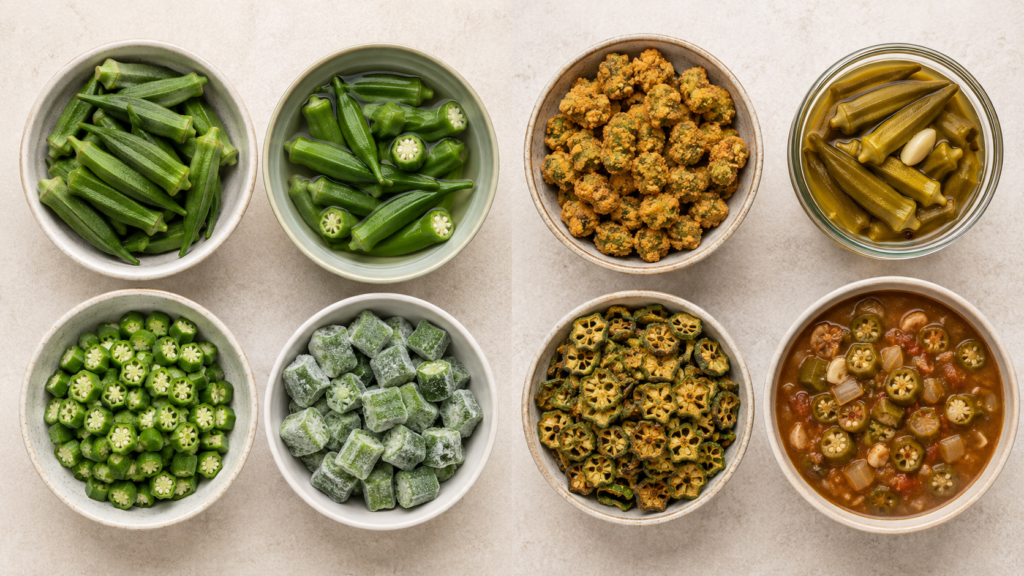
Which Forms of Okra Are Safe for Dogs?
Preparation matters. Compare common forms of okra before offering any to your dog.
| Form of okra | Safety status | Practical guidance |
|---|---|---|
| Plain steamed okra | Usually safe | Soft, easy to portion, and best served plain. |
| Plain boiled okra | Usually safe | Drain, cool, and cut into bite-sized pieces. |
| Raw okra | Use caution | Tougher to chew; chop finely to reduce choking risk. |
| Frozen okra | Usually safe | Choose an unseasoned product and thaw or cook it. |
| Roasted okra | Sometimes | Avoid oil, salt, onion, garlic, and spice blends. |
| Grilled okra | Sometimes | Serve plain, tender, and in small pieces. |
| Fried okra | Avoid | High fat and oil may cause gastrointestinal upset. |
| Breaded okra | Avoid | Adds fat, sodium, and potentially unsafe seasonings. |
| Pickled okra | Avoid | Brine is often high in sodium and may contain garlic. |
| Canned okra | Check the label | Choose plain, low-sodium products without unsafe additives. |
| Okra chips | Use caution | Often contain oil, sodium, garlic powder, or onion powder. |
| Okra soup or gumbo | Often unsafe | Recipes commonly contain onion, garlic, sausage, salt, or fat. |
| Okra and tomatoes | Recipe dependent | Use only a plain recipe without onion, garlic, excess salt, or rich sauce. |
| Okra seeds | Usually acceptable | Tender seeds are normally eaten as part of the pod. |
Possible Nutritional Benefits
Okra’s botanical name is Abelmoschus esculentus. It is also known as lady’s finger or gumbo and belongs to the mallow family.
The slippery texture inside an okra pod comes from mucilage, a group of gel-forming plant polysaccharides. Research also identifies polyphenols and other antioxidant compounds in the plant.
USDA nutrient data list approximately 33 calories and 3.2 grams of dietary fiber in 100 grams of raw okra. Okra also contains:
- Vitamin C
- Vitamin K
- Folate
- Potassium
- Magnesium
- Calcium
- Beta-carotene
- Lutein
- Zeaxanthin
- Polyphenols and other antioxidants
Nutrient amounts vary with the variety, maturity, storage, and cooking method.
These entities describe okra’s nutrient profile. They do not prove that okra creates a clinical benefit in dogs.
A dog eating an appropriate complete and balanced diet should already receive the essential nutrients required for health. Okra is an optional treat, not a supplement, medicine, or treatment for diabetes, cancer, inflammation, or digestive disease.
Possible Risks and Side Effects
Gastrointestinal Upset
Too much dietary fiber or a sudden new food may cause diarrhea, vomiting, gas, or bloating.
Introduce okra gradually. Stop feeding it if your dog repeatedly reacts poorly.
Choking
A whole pod or large, firm piece may lodge in the throat. Small dogs, puppies, senior dogs, and dogs that gulp food face greater risk.
Pancreatitis and High-Fat Recipes
Fried okra and breaded okra contain far more fat than plain okra.
High-fat table foods can cause stomach upset and may contribute to pancreatitis in vulnerable dogs. Common signs of pancreatitis include nausea, vomiting, lethargy, diarrhea, reduced appetite, and abdominal pain. However, diet is not the identifiable cause of every pancreatitis case.
Sodium and Toxic Seasonings
Pickled okra, canned okra, okra chips, and gumbo may contain excessive sodium.
Onion and garlic are more serious concerns because they are toxic to dogs. Check labels for onion powder and garlic powder as well as fresh ingredients.
Food Allergy or Intolerance
An individual dog can react poorly to almost any new food. A food intolerance may cause vomiting, diarrhea, or gas.
A true food allergy usually causes recurring symptoms following exposure. These may include itching, skin inflammation, ear problems, or gastrointestinal signs.
Facial swelling, widespread hives, collapse, or breathing difficulty requires emergency care.
Oxalates and Prescription Diets
Okra contains oxalates. A human study found that the oxalate in its tested okra serving had low bioavailability. However, that research does not establish a safe amount for dogs or prove that okra prevents or causes canine urinary stones.
Ask your veterinarian before feeding okra to a dog with:
- Calcium oxalate urinary stones
- Kidney disease
- A urinary disorder
- A prescription veterinary diet
Do not add unapproved treats or meal toppers to a therapeutic diet.
Symptoms and What They May Indicate

Symptoms and What They May Indicate
Use this guide to identify possible digestive reactions and signs that may require urgent veterinary care.
| Symptom | What it may suggest |
|---|---|
|
Mild gas or one soft stool
Monitor
|
Digestive sensitivity or excess fiber. |
|
Repeated vomiting
Contact a vet
|
Stomach irritation, pancreatitis, obstruction, or toxin exposure. |
|
Abdominal pain or a “prayer position”
Contact a vet
|
Significant gastrointestinal pain or possible pancreatitis. |
|
Drooling, gagging, or pawing at the mouth
Act promptly
|
Oral irritation, choking, or a lodged piece. |
|
Pale gums, weakness, rapid breathing, or dark urine
Urgent care
|
Possible red-blood-cell injury after onion or garlic exposure. |
|
Swollen abdomen or repeated unproductive retching
Emergency
|
A potentially life-threatening emergency. |
|
Tremors, collapse, or breathing trouble
Emergency
|
Immediate emergency veterinary care is needed. |
These symptoms overlap across many conditions. Do not try to diagnose their cause at home.
When Not to Google: Call a Vet Immediately
Stop searching and contact a veterinarian, emergency clinic, ASPCA Animal Poison Control, or Pet Poison Helpline when:
- The dish contained onion, garlic, xylitol, alcohol, or another known toxin.
- Your dog ate a large or unknown amount.
- Your dog is choking or struggling to breathe.
- Vomiting is repeated or contains blood.
- Diarrhea is severe, persistent, or bloody.
- Your dog is weak, confused, trembling, or collapsed.
- The abdomen appears swollen or painful.
- Your dog cannot keep water down.
- Your dog is a very young puppy, frail senior, pregnant, very small, or medically fragile.
- Your dog has pancreatitis, diabetes, kidney disease, food allergies, gastrointestinal disease, urinary stones, or a prescription veterinary diet.
Where Pain or Discomfort May Appear
Mouth or throat discomfort may cause drooling, repeated swallowing, gagging, coughing, or pawing at the face. These signs can indicate irritation or a lodged piece.
Belly discomfort may cause:
- Restlessness
- Whining
- A hunched posture
- Repeated stretching
- Guarding of the abdomen
- The “prayer position,” with the chest lowered and rear raised
Severe or persistent abdominal pain needs urgent veterinary assessment.
Common Misconceptions
“If okra is healthy for people, it must be healthy for dogs.”
Dogs have different nutritional needs. Human health claims cannot automatically be applied to dogs.
“A small amount can never hurt.”
A small piece of plain okra is low risk for most dogs. A small amount of concentrated garlic, onion seasoning, or another toxin may still be dangerous.
“Natural foods are always safe.”
Chocolate, grapes, onions, garlic, and many toxic plants are natural. Natural does not mean pet-safe.
“Dogs can eat anything wolves ate.”
Modern companion dogs have individual nutritional requirements, medical conditions, and calorie needs. Comparisons with wild wolves do not establish food safety.
“One safe ingredient makes the whole recipe safe.”
The okra may be harmless while the gumbo, pickle brine, breading, stock, or seasoning is not.
“If my dog likes it, it must be good.”
Dogs may eagerly eat fatty, salty, spoiled, or toxic foods. Preference does not establish safety.
Recovery Timeline: What to Expect
A dog that eats one small piece of plain okra may show no symptoms.
Mild digestive signs can appear within several hours, especially after a larger portion or sudden dietary change. Do not rely on a guaranteed recovery time.
Contact your veterinarian if:
- Vomiting or diarrhea repeats
- Abdominal pain develops
- Your dog becomes lethargic
- Your dog refuses food or water
- Symptoms become worse
- Symptoms fail to improve
Some hazards may not cause immediate signs. Onion- or garlic-related red-blood-cell damage can be delayed, while choking, obstruction, gastric dilatation-volvulus, or severe pancreatitis may worsen quickly.
Puppies, Senior Dogs, and Dogs With Health Conditions
Can puppies eat okra? A healthy puppy may tolerate a tiny piece of plain, soft okra. However, puppies need a carefully balanced growth diet, and human foods should not displace puppy food.
Hard or oversized pieces can also create a choking hazard.
Senior dogs and toy breeds may need softer, smaller pieces. Dogs with pancreatitis should avoid fried or fatty okra dishes.
Seek veterinary guidance before feeding okra to dogs with:
- Diabetes
- Kidney disease
- Gastrointestinal disease
- Food allergies
- Urinary stones
- Chronic pancreatitis
- A prescription veterinary diet
A veterinarian or board-certified veterinary nutritionist can determine whether okra fits your dog’s individual nutrition plan.
Better Dog-Friendly Alternatives
When your dog does not tolerate okra, consider a small amount of plain:
- Cooked green beans
- Carrot
- Cucumber
- Zucchini
- Plain pumpkin
- Blueberries
Introduce any new food gradually. Serve it without butter, oil, salt, sauce, or seasoning, and keep all extras within the 10% treat rule.
Frequently Asked Questions
Can dogs eat okra raw?
A small piece of washed, finely chopped raw okra is unlikely to be toxic. However, cooked okra is softer and easier to portion.
Do not offer a whole raw pod to a small dog or puppy.
Can dogs eat cooked okra?
Yes. Plain cooked okra for dogs is usually the safest form.
Choose boiled okra or steamed okra without oil, butter, salt, sauce, or seasoning.
Can dogs eat okra every day?
Okra is better as an occasional treat. Daily extras can add calories, cause digestive upset, and displace a complete and balanced diet.
Is okra bad for dogs?
Plain okra is not usually bad for dogs when served in a small portion.
Fried, pickled, heavily salted, seasoned, or oversized servings may cause problems.
Is okra safe for dogs?
Plain okra is generally considered safe for most healthy dogs in moderation. The preparation method, serving size, recipe ingredients, and dog’s health determine the actual risk.
Is okra toxic to dogs?
Okra itself is not generally regarded as toxic.
Onion, garlic, excess fat, sodium, and other recipe ingredients may create the real danger.
How much okra can a dog eat?
No research-based canine serving size exists.
Start with one bite-sized piece. Keep all treats and extras below 10% of your dog’s daily calorie intake.
What happens if my dog eats too much okra?
Too much okra may cause gas, bloating, vomiting, soft stool, or diarrhea.
Contact a veterinarian after a large ingestion or when symptoms are repeated, severe, or accompanied by pain or weakness.
Can dogs eat okra with tomatoes?
It depends on the recipe. A small amount of plain okra with ripe tomato may be acceptable, but avoid onion, garlic, rich sauce, heavy salt, or spicy seasoning.
Can dogs eat okra soup or gumbo?
Usually not. Okra soup and gumbo often contain onion, garlic, sausage, salty stock, spices, or added fat.
Can dogs eat okra chips?
Use caution. Commercial okra chips often contain oil, sodium, onion powder, garlic powder, or other seasonings. Their dry, hard texture may also increase choking risk.
Should I call a vet if my dog ate okra?
Call when the recipe contained a toxin, the amount was large or unknown, your dog has a relevant medical condition, or concerning symptoms appear.
Submit Your Story
Has your dog eaten okra by accident, or do you use it as an occasional meal topper?
Share your experience in the comments. Your story may reassure another dog owner, but a comment section cannot replace veterinary care for serious symptoms.
Final Verdict: Can Dogs Eat Okra?
Can dogs eat okra? Yes, most healthy dogs can have a small amount of plain, soft okra in moderation.
Steamed or boiled okra, cooled and cut into bite-sized pieces, is the safest choice. Avoid fried okra, breaded okra, pickled okra, salty products, and recipes containing onion, garlic, excessive fat, or other toxic seasonings.
Introduce okra gradually. Treat it as an optional extra and keep it within the 10% treat rule.
Call a veterinarian immediately for choking, breathing trouble, repeated vomiting, severe diarrhea, abdominal swelling or pain, collapse, marked weakness, or possible toxin exposure.
How This Article Was Created
This article was prepared using:
- Veterinary nutrition principles
- Veterinary poison-control guidance
- Pet-food safety standards
- USDA FoodData Central nutrient information
- WSAVA treat guidance
- AAFCO nutritional-adequacy concepts
- Evidence-based medical-writing practices
- Modern SEO and answer-engine formatting
The article uses answer-first summaries, descriptive headings, tables, concise definitions, entity-rich language, and direct FAQ answers to support traditional SEO, AI search, answer engines, generative search, large language models, and human decision-making.
This content is for educational purposes only. It does not replace advice, diagnosis, or treatment from a veterinarian.
Do not state that this article was “veterinarian reviewed” unless a licensed veterinary professional has completed and documented that review.
Further Reading and Source Scope
Preventive Vet: vegetable safety, including okra. Consult this source for the relevant food or ingredient precautions. This reference is provided by our editorial team and does not mean a veterinarian has reviewed this article. Ask your own veterinarian for advice that accounts for your dog’s health and diet.